
Table formats#
MARIO handles both Input-Output Tables (IOTs) and Supply and Use Tables (SUTs). They share many workflows, but they do not carry the same internal structure.
Input-Output Tables (IOTs)#
IOTs, also known as symmetric input-output tables, represent a squared representation of a productive system. The main native flow matrices are:
Zfor intersectoral flowsYfor final demandVandVYfor factors of productionEandEYfor satellite accounts
From these flow matrices MARIO can derive coefficient matrices such as z,
v and e (and viceversa), the total production vector X, and demand-driven results
such as footprints (f and F), multipliers (m and M) and prices indices (p).
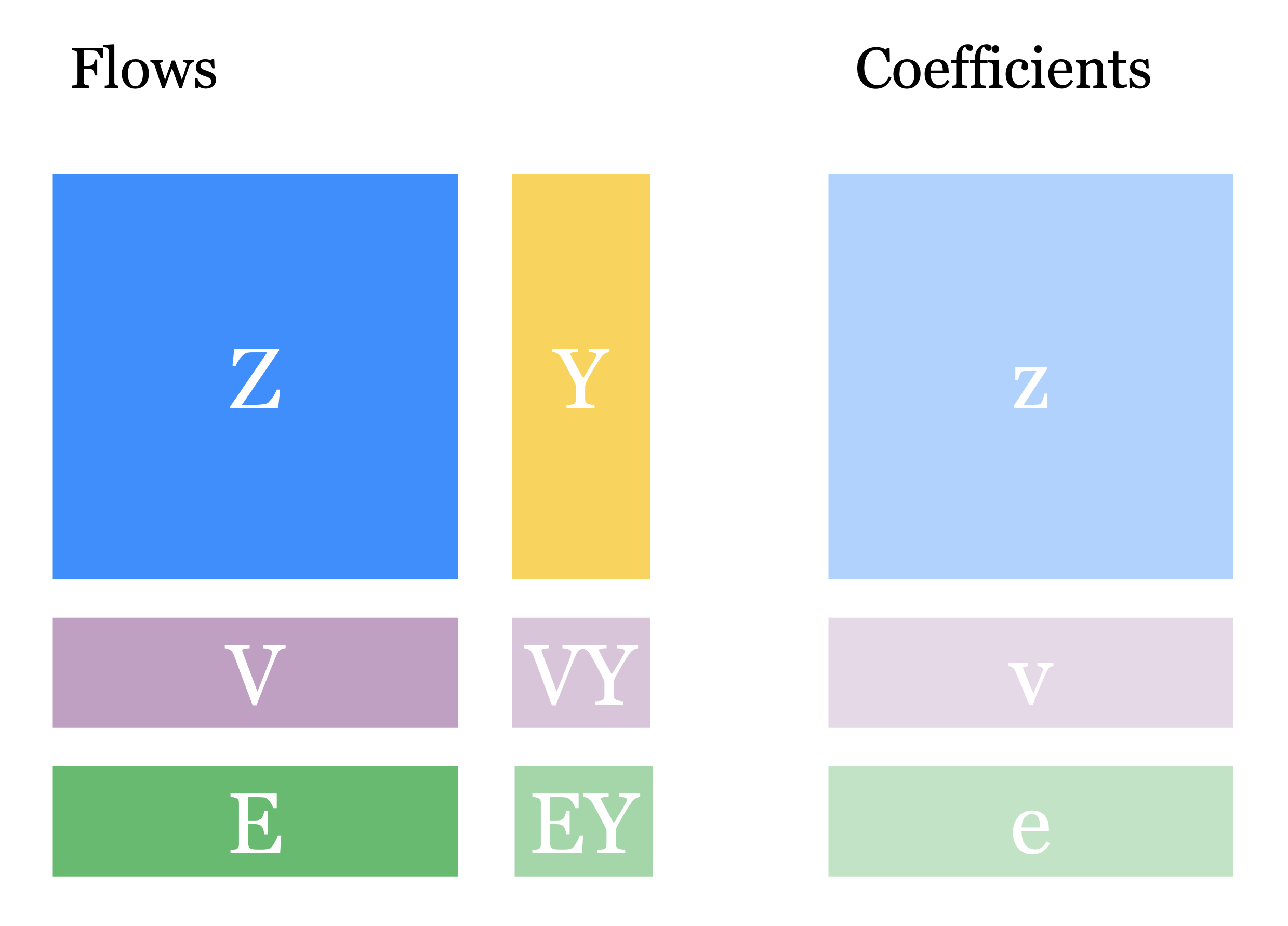
Native IOT flows matrices on the left and the corresponding coefficient matrices
on the right. Matrices Y, VY and EY are always expressed in flows#
Supply-Use Tables (SUTs)#
SUTs, unlike IOTs, distinguish between commodities and the activity supplying them. The native flow matrices are split into activity-side and commodity-side blocks:
UandSYcandYaVc,VaandVYEc,EaandEY
While U and S are commonly known in input-output literature as Use and
Make or Supply matrices, MARIO uses the a and c suffixes to indicate
the activity-side and commodity-side parts of Y, V and E.
Some of these matrices may be entirely null and therefore absent in some databases!
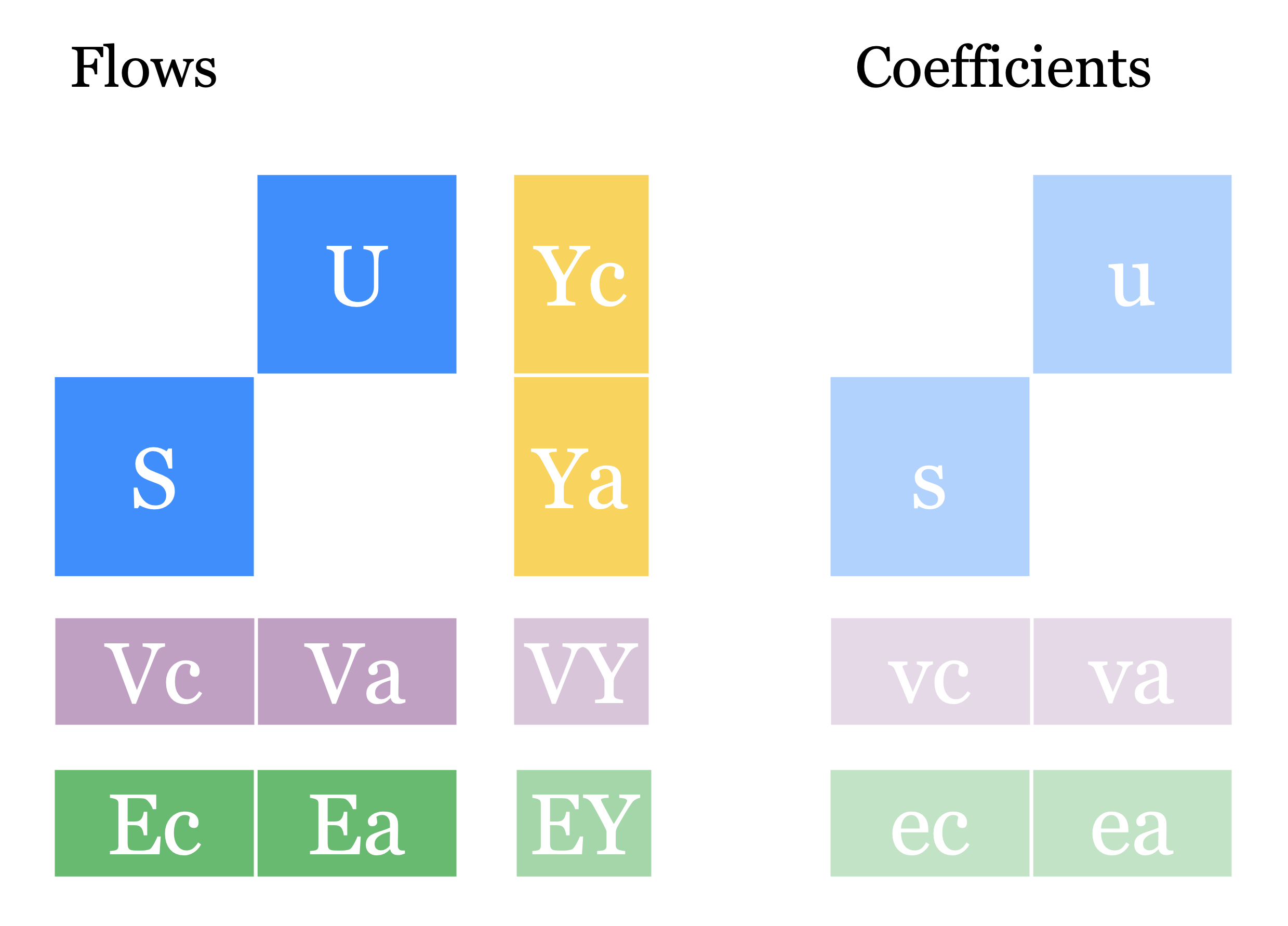
Native SUT flows matrices on the left and the corresponding coefficient matrices
on the right. Matrices Yc, Ya, VY and EY are always expressed in flows#
Important
MARIO can also generate unified views for SUTs such as Z, Y, V and
E on top of the standard matrices. These are convenient for inspection and
some exports, but they are not the most native representation of a SUT
database. This feature is particularly useful for retrocompatibility with
versions up to v0.3.5.
Important
When computing a matrix, MARIO will calculate all the dependencies automatically.
Why this matters#
In principle, many operations are common to both table formats. One can even apply the same mathematics of IOTs to SUTs in a formal sense: see Lenzen and Rueda-Cantuche 2012. In practice, however, efficient SUT formulas depend on the underlying supply and use structure. Parsing, calculations and table transformations therefore need to know whether a database is IOT or SUT.
Check available matrices in a database#
Matrices are stored in a dictionary within the database class and are defined for each scenario.
If you want to check which matrices are available in the baseline scenario:
db.list_matrices(scenario="baseline")
The resulting list is dynamic: after parsing the database, every matrix the user computes is stored in this dictionary.
Download the terminology workbook#
If you want a compact overview of how the different matrices are obtained for
both IOT and SUT databases, download the
terminology workbook.
Upcoming work#
Even if, for the moment, no additional table formats are envisaged, future developments may go in the direction of including Social Accounting Matrices (SAMs). Let us know if you are interested in having SAMs or other table formats by opening an enhancement issue on GitHub!